Emperor's Council of Advisors
His Property (A Dark Vampire High School Bully Romance) (Vampire Boy Swords): Prince of Londinium (Dead Sun: Prince of Londinium (A Dark High School Bully Romance) (Vampire Boy Swords) Book 1)The Emperor's Council of Advisors is a central institution of the Londinium court, and its importance lies less in any described administrative procedure than in the protection its membership confers. Lord Phraeon's seat on the council places him inside the Emperor's ruling structure even while he is implicated in the kidnapping of Clara and her friends. That overlap between suspected criminality and official authority turns the council into a visible instrument of political immunity.
Nature and Position
The council is attached to the Emperor's government in the underground city of Londinium. The court operates within a highly stratified society in which titles such as Lord, Prince, and Lord Protector carry practical force, and the council's authority is part of that wider political order. The evidence does not enumerate its members or state its formal powers, but it establishes that Lord Phraeon is one of its advisors and that this position materially affects what can be done against him.
The council also belongs to a dynastic system shaped by the history of the Taleians. Prince Octavius explains that the ancient Taleians were divided into clans and governed by a Queen from the first Royal Clan, while the Breannin Clan formed the second royal clan and supplied the Queen's Knight of Swords and her knights. In the older order, bloodline, counsel, protection, and mating were inseparable: the Book of Talus designated mates who would serve as protectors and advisors to the Queen. The modern council therefore appears against a background in which political legitimacy has long been connected to sacred ancestry and personal guardianship, even though the Emperor has attempted to suppress reminders of that heritage.
Political Protection and Impunity
The council's most concrete plot function is revealed when Louise Turner asks why Lord Phraeon has not been arrested after the kidnapping. Clara explains that Darius cannot arrest him because no proof connects him to the crime and because Phraeon sits on the Emperor's Council of Advisors. The council is thus not merely a place where Phraeon holds office; his membership helps make the absence of punishment intelligible. Suspicion exists, but suspicion cannot overcome the combination of missing evidence and institutional standing.
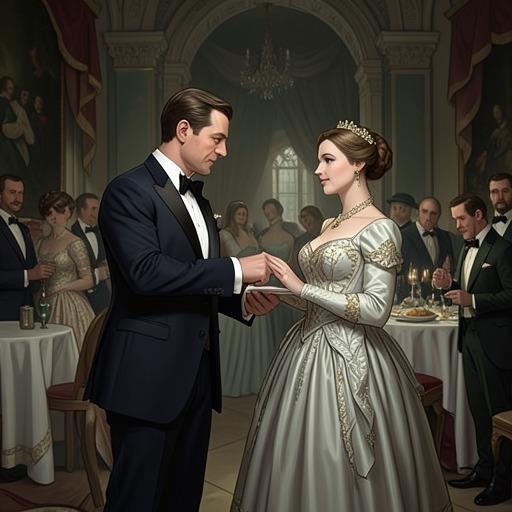
This protection gives Phraeon room to pursue Clara publicly. At the ball, he leads her around the dance floor, kisses her in full view of Darius, Prince Octavius, Carter, and Raine, and treats the kiss as a possessive mark. He then claims that the rules of courtship allow him to stake a claim upon her. His confidence is sharpened by the fact that he is not an outsider challenging the court from beyond its walls. He is a court advisor who can convert ceremony, status, and an ambiguous ritual rule into leverage over a woman who rejects the idea that she belongs to anyone as property.
Conflict with the Court's Other Authorities
The council exists within a contested hierarchy rather than a stable consensus. Darius, the Lord Protector of the city, pulls Clara away from Phraeon and declares that she is under his protection. Phraeon answers that Darius has designs of his own on Clara and argues that he has already established a lawful courtship claim through the kiss. The exchange places the council's advisor, the city's protector, and the royal prince in direct conflict over who may define Clara's status and who may act in her defense.
The dispute becomes more dangerous because the courtship system is enforced through challenge and bodily claiming. Darius later tells Octavius that the challenges must be fought before the winner can claim Clara with his bite and brand. Octavius, meanwhile, insists that he must protect her from challengers and presents himself as a skilled swordsman rather than the pampered prince others assume him to be. The council's political world therefore intersects with a ritualized combat order in which institutional rank does not eliminate rivalry but supplies the contestants with competing forms of legitimacy.
Relation to Imperial Historical Power
Octavius's account gives the council a darker historical setting. He says that his father, the Emperor, wants no reminder of the Empress's rule, the hybrids' role in helping the Taleian people survive their evolution, or the aliens who joined with them. Under the Empress, the five Princes and the Book of Talus served as mates and advisors who guarded her power and kept her loved and safe. Octavius further states that his father murdered the Empress, her child, and the Princes.
Within that account, the modern council can be read as part of a regime that has inherited the machinery of counsel while severing it from the older system's claimed reciprocity and nurture. The narrative does not state that the council directly participated in the murders, nor does it identify its members beyond Phraeon's position. It does show, however, that the Emperor's present order can contain a man accused of kidnapping while the surviving truths of the previous dynasty remain suppressed. The council's existence consequently carries the tension between continuity and erasure: it preserves a governing form while the imperial household attempts to control the history that once gave royal counsel its meaning.
Narrative Significance
The Emperor's Council of Advisors makes political power tangible in a scene otherwise dominated by romance, ritual, and personal coercion. Clara's experience demonstrates that the danger she faces is not produced only by the desires of individual men. Phraeon's authority is reinforced by office; Darius's protection is backed by his role as Lord Protector; Octavius invokes royal duty, swordsmanship, and the inherited rules of the Taleian order. Each institution turns a personal claim into something that resembles law.
The council also dramatizes the gap between official legitimacy and moral legitimacy. Phraeon is treated as a recognized advisor despite the accusation surrounding the kidnapping, while Clara's own testimony and refusal do not automatically cancel his claim. Her body becomes the site where political office, dynastic blood, courtly spectacle, and ritual law compete. By placing the accused advisor at the center of that contest, the narrative presents the council as a structure of sanctioned access: it does not need to be shown issuing an order to shape events, because its membership already determines who can avoid arrest and who can press a claim in public.